 Recently I wrote a post about the fact that I think most men should keep their shirts on even when the weather becomes unbearably hot.
 I have to say that when I admitted this on Facebook, a few people gave me grief about it and hinted that I was being hypocritical.
It's possible that making a joke about shirtless men on Facebook (by asking them to put away their "man boobs," which one friend called "moobs") was hypocritical in the sense that it sends the message it's okay to make fun of people's bodies. Yes, that's true, and I'm sorry if I sent that message.
Though I also think it's possible to take ourselves TOO seriously.
But I don't think that my attitude about men needing to keep their shirts on is hypocritical at all, and I'd like to explain why.
This blog is designed to help people understand two things: 1) why dieting is unhealthy and has caused many people to gain weight over the long haul, and 2) how important it is for people to accept themselves the way they are. As I've said before, I don't think sustained weight loss or healthy living is possible without understanding these ideas.
Part of accepting ourselves requires us to see what it is that makes each of us beautiful and then showing off that beauty by highlighting our best features.
This first part is pretty straightforward (after you do the hard work of seeing what makes you beautiful): if you have great legs, you can show them off by wearing more skirts. If you have a defined waist, buy more clothes that feature your middle. If you have gorgeous green eyes, wear more red to make them stand out. (I often wear orange or blue because my eyes are blue.) That kind of thing.
These ideas are not revolutionary, but they really can improve your self-esteem and, therefore, positively affect your life. Half the time I wear blue someone comes up to me and says, "Wow, your eyes look amazing!" That's the kind of thing that makes me feel like I'm on top of the world. There is no substitute for a good compliment, and I'll take them any way I can get them.
(Incidentally that is also why I ALWAYS tell other women when I like something about their appearance—whether it be their shoes, their hair, or whatever. I think it's important that we hand out compliments as much as we can—about our appearance or anything else.)
The second part of accepting ourselves the way we are requires us to dress for the bodies we have, and that can be a lot trickier.
The hardest part is figuring out what body you have. I'm still never sure if I have a pear-shaped body or an apple-shaped body or simply fall under the "plus-size" umbrella. (Glamour magazine has a great monthly column about picking a certain piece of clothing for your body shape and size—last month it was bathing suits—and I never know which shape I am, so I usually look at more than one.)
Equally difficult is following the rules for your body. Sometimes this is hard because our bodies change, and we don't know it right away. In fact, it can take Y E A R S to figure this out.
For instance, I've always had a defined waist, so I've never worried about wearing unstructured clothing on top. I love a lightweight slouchy t-shirt in the summer almost as much as I love hot dogs and watermelon at a picnic, but lately I've noticed that when I wear flimsy t-shirts to a party where someone is taking pictures, the photos come back with me looking like I have a little roll around my belly even though that part of my body is pretty fit. Part of the problem is my posture. I have never learned to stand up straight, so when I'm sitting, my shoulders roll forward and cause my stomach to look bigger than it is. The other problem is that even though my stomach is relatively small, it's not as small as it was when I was younger. No matter the cause, the pictures are always awful, and so I've vowed to stop wearing those kinds of unstructured tops when I might be photographed.
I had the same problem with short skirts when I was younger.
I was always a fan of the miniskirt and, until I was in my late-twenties, could pull it off. But after I gained weight from an accident, I didn't realize that the look was no longer flattering until I saw some pictures from a bridal shower where I wore a panty-skimming dress (what was I thinking???) and started watching What Not to Wear, a show that pushes the "no miniskirts after thirty-five" rule. Now I swear by this rule too because—I don't care how thin you are—after a certain age, a knee-length skirt is much sexier than a mid-thigh one.
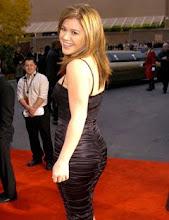
The picture above of one of the thinnest woman alive, Nicole Kidman, proves my point.
(I wish Heidi Klum would follow Nic's lead and give up minis.)
Nicole looks sexy as hell in this photo, but if she had gone four inches shorter, she would have looked like she was trying too hard to hold onto her youth. In fact, the longer skirt actually makes her look younger. Some people call this aging gracefully, but that can make people feel old—better to simply think of it as looking your best.
This is the same place where my negative attitude about shirtless men comes in.
I think men over the age of twenty-five take their shirts off when they working out for two reasons: 1) because they're hot (which bothers me because women don't have the same option), but more importantly, 2) because they started doing so when they were teenagers and haven't stopped and looked in the mirror long enough to realize how much their bodies have changed. And if they did, I imagine they would think twice about baring their chests to the world.
The reason I think they shouldn't bare said chests if they're not in great shape is because doing so is NOT dressing for the body you have. It's dressing for the body you used to have. To me, an out-of-shape man taking his shirt off in public is no different than a forty-something woman walking out the door in a micro-mini: it should just be avoided. Even if technically she or he can still pull it off.
The same could be said about muffin tops.
If your jeans are so tight that a layer of fat spills out of the top, it's time to get a new pair. One really important lesson I've learned is that it is ALWAYS worth it to buy new clothes rather than stuffing yourself into the old ones. You will immediately feel better in a new pair of jeans but feel lousy for a long time if you have to lie down on your bed to zip your old ones.
I don't mean to send the message that we all need to cover ourselves up. On the contrary I'm all about showing it off. I hate sack dresses and muumuus and polygamist-type clothes more than almost anything. I believe in showing off our assets—in skirts that skim the knee and shirts that show off a great set of arms. (I also understand that sometimes we just want to blow off the rules, which is fine too.)
But I think showing off our liabilities is just plain silly.
And admitting you have liabilities is not inconsistent with the message of this blog or even hypocritical because it's in line with what the blog is about—which is focusing on what makes you beautiful. But you can't do that if you're not honest with yourself about what your less-than-perfect features are too.
I guess what I'm trying to say is that body acceptance is not only about appreciating your beauty, it's also about being okay with the fact that none of us are perfect. And I hope more than anything that you will understand that recognizing your imperfection doesn't mean that you have to be ashamed of them, but it also doesn't mean that you need to flaunt them either.
F. Scott Fitzgerald famously said that "The test of a first-rate intelligence is the ability to hold two opposed ideas in mind at the same time and still retain the ability to function." Being able to do so—hold two opposing ideas in your head at the same time—also allows people to understand why I want everyone to accept themselves the way are AND dress for the body they have. And from my point of view, these are not mutually exclusive ideas.





 Posts
Posts

