Showing posts with label Gabby Sidibe. Show all posts

Tuesday, March 1, 2011

The 2011 Oscars: Playboy Barbie edition
a.k.a. two steps forward, two steps back

Last year, I spent the days after the Oscars and Golden Globes talking about how much curvier the red carpet was, how women of all sizes should dress, and how Hollywood allows women of color to be curvier than white woman.

Unfortunately, I couldn’t talk about any one of these issues this year even if I wanted to because there were almost no curvy women or women of color on the red carpet this year.

So what happened? Where were all the women of color? And what about the curvy women? Where were they? Because the only curve I noticed on the red carpet Sunday night was the moon-shaped baby bump under Natalie Portman’s plum-colored dress.

Okay, so Penelope Cruz was showing off a little extra stomach, arm, and thigh (not to mention boob) post-baby, but other than that, the red carpet was curve-free. (In case you’re wondering, breasts alone don’t make a woman curvy.)
1298855279_penelope-cruz-oscar_290.jpg

Last year there were nine curvy girls on the red carpet— JLo, Mo'nique, Meryl Streep, Gabby Sidibe, Molly Ringwald, Queen Latifah, Mariah Carey, Sigourney Weaver, and Kate Winslet (FYI... I wouldn’t call Winslet curvy, but since one reporter called her “big” that night, she deserves to stand with us)—and eight women of color: Mo'Nique, Gabby Sidibe, Queen Latifah, Mariah Carey, Zoe Saldana, JLo, Penelope Cruz, and Cameron Diaz. This year, real-sized woman dropped to two—Cruz and nominee Jacki Weaver—while women of color were down to just three: Cruz again, JHud, and Halle Berry.

And that wasn’t the only place women were missing. When Spielbeg introduced the award for best picture, the girls at BitchFlicks rightly pointed out that he mentioned eight films that had been previously nominated for—The Grapes of Wrath, Citizen Kane, The Graduate, Raging Bull—and won—On the Waterfront, Midnight Cowboy, The Godfather, The Deer Hunter—the best picture Oscar, but not one of them was about a woman or a person of color.

This was in stark contrast to last year’s Academy Awards, which, as I said then, was an evening focused on strong women—Sandra Bullock, Mo'nique, Meryl Streep, Gabby Sidibe, and of course Best Picture/director winner Kathryn Bigelow to name a few—and that those women thankfully had bodies of all sizes

And if women were more of an afterthought this year and women of color and curvy women glaringly absent on the red carpet, I can’t help but wonder if this means we are regressing.

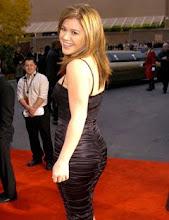
Reese Witherspoon showed up in a look that was frighteningly reminiscent of a Playboy bunny (see picture above), and I visibly shuttered when I saw her on my TV screen. Are we going backwards instead of forwards? Will we be breaking out the corsets and bonnets next year?

The irony is that one of the only women of color on the red carpet was Jennifer Hudson, who, over the last year, has famously replaced her ample curves with ones that are more Hollywood appropriate.

Maybe the lack of curves on the red carpet was the reason why JHud’s new bod seemed to be all anybody could talk about when they saw her. Even the normally infallible Tim Gun felt the need to point out Hudson’s “amazing new figure.”

Even worse, when Ryan Seacrest interviewed Hudson, he said, “You must love getting dressed up now that you have that new body.”

It’s bad enough Seacrest felt comfortable giving Hudson such a back-handed compliment, but his comment is also offensive to the rest of us non-Red Carpet walkers because his message is that if we aren’t skinny, then we shouldn’t enjoy dressing up.

Guess what, Ryan? Real women—whether they be curvier than celebrities or more flat chested than them—like to dress up too!

The bottom line is that the more we talk about Hudson's "new" bod, the more we reinforce the idea there was something wrong with the old one. And, my God, the woman is gorgeous at any size.

After the Golden Globes this year, I wrote about how Seacrest’s superficial and sexist banter on the red carpet hurts us more than Ricky Gervais’ raunchy ribbing of celebrities, and this year’s color-and-curve-free red carpet makes me think it’s time for another course correction.

Over the past few years, we have seen a resurgence of curvy women and women of color, but last Sunday proved that, unfortunately, we’re falling back into old habits. This means that we have to re-double our efforts by continuing to demand more magazines and models with real women and by continuing to vote with our dollars and spend money on female artists of all stripes.

Recently, when asked if the new emphasis on curves would continue, a world-famous designer said that, in fashion, trends come and go pretty quickly, and he imagined that the curvier women we’ve seen on the runway over the past year would not return next season. But if trends come and go that fast, then we wouldn’t have seen the same Kate Moss heroin chic bodies for the past fifteen years. From my point of view, this sounds like an excuse—and one we cannot accept.

Thursday, March 11, 2010

The Oscars, Part II:
Where are all the curvy white women???

192 pounds
If you didn't watch the Oscars on Sunday, then you might not know that, in her acceptance speech, Oscar winner Mo'Nique mentioned Hattie McDaniel, the first African American to win an Oscar for her supporting role as "Mammy" in 1939's Gone with the Wind. Mo'Nique said, "I want to thank Miss Hattie McDaniel for enduring all that she to, so that I would not have to."

The next day, commentators were discussing Mo'Nique's acceptance speech and one of them also included a video of McDaniel's original speech, which I watched immediately.

As I watched McDaniel accept her Oscar, it hit me rather suddenly that her body, like Monique's and Gabby Sidibe's, wasn't typical of Hollywood actresses.

And that made me think more deeply about an issue that I often don't talk about: the fact that in our society women of color are allowed to be curvy, and "white" women are not.

I'm not saying this is a hard-and-fast rule. There are certainly women of color—Halle Berry, for instance—who are super thin, and I'm sure there are "white" women who are not—Kathy Bates comes to mind. But, for the most part, in the mainstream media, women of color are given more latitude in terms of what their bodies can look like than their white counterparts. A quick glimpse at my Gallery of Gorgeous Women proves that.

Still don't believe me?

Let's do a quick rundown of who was on the Red Carpet . . .

Mo'Nique, Gabby Sidibe, Queen Latifah, Mariah Carey, and Zoe Saldana were the African American women who walked the Red Carpet before the ceremony. Four out of five of those women could not fit into the sample sizes used at Fashion Week.

JLo, Penelope Cruz, and Cameron Diaz were the only Latinas there Sunday night. JLo is obviously curvier than most of her "white" peers, and Cruz is on the fence—she's got some real curves, but she's also pretty fit. Diaz, on the other hand, has always been super thin and is the only one of these three who clearly fits into the waif-like model, but one could argue that most people are ignorant of Diaz' Cuban roots, meaning she has to fit into the "white" model of beauty despite her ethnicity.

And what about the "white" actresses?

That list includes Sandra Bullock, Kathryn Bigelow, Charlize Theron, Maggie Gyllenhaal, Rachel McAdams, Carey Mulligan, Anna Kendrick, Amanda Seyfried, Helen Mirren, Demi Moore, Sigourney Weaver, Kristen Stewart, Elizabeth Banks, Sarah Jessica Parker, Diane Kruger, Kate Winslet, Nicole Richie, Miley Cyrus, Tina Fey, and Meryl Streep.

Are you seeing what I'm seeing?*

Out of these twenty women, only two have slightly real bodies . . .

Meryl Streep and Sigourney Weaver.

Let me repeat that . . . only two of the twenty "white" actresses on the Red Carpet last week have a normal body, and both of them are not only older than the others, they are also already established forces in Hollywood, a feat I might add they both accomplished when they were still very, very thin.

And really, let's be honest . . . Streep and Weaver have phenomenal bodies. Neither one of them are the slightest bit overweight. Who knows what I would do to look like them? Certainly, I wouldn't kill for a great bod, but I might lie, cheat, and steal to get one. And in that sense, they really can't even be put into the same category as people like Mo'Nique, Sidibe, Queen Latifah, or even the always voluptuous Lopez and Carey.

So why the double standard, Hollywood? Why are you willing to accept women of color in all shapes and sizes but only accept "white" girls who look like they stopped eating after puberty? I mean, really, Hollywood, what gives?

I don't know the answer to these questions and I fear that racism has something to do with some of it, but I do know this: until we allow women of ALL races and ethnicities to be different shapes and sizes, we will never have a healthy idea of what women's bodies should look like.

*I'm also seeing that "white" actresses significantly outnumber non-"white" actresses, which is another problem, but not one that has to do with the themes of this blog.

Tuesday, March 9, 2010

The Oscars, Part I: A plea to all Hollywood starlets

192 pounds
As I'm sure you all know, the Oscars were Sunday.

It was a great day for women because Kathryn Bigelow was the first woman in history to take home the Academy Award for Best Director. And her film—The Hurt Locker—also won the Best Picture award.

I also felt like the narrative of the evening focused on strong women—Sandra Bullock, Mo'nique, Meryl Streep, Gabby Sidibe, and Bigelow to name a few—and that those women thankfully had bodies of all sizes.

But before the actual ceremony began, I found myself cringing during the Red Carpet show.

At first I wasn't sure why the Red Carpet didn't have as much appeal for me as it normally does, but after the first sixty minutes or so, I put it together: many, many of the women who walked it looked too thin to me. To the point that they almost looked as if they were sickly.

I've made it a point on this blog NOT to criticize skinny women or name names about women who I think look like they are at an unhealthy weight, and I think I'll stick with that decision because it doesn't really help anyone to attack the way certain women look—whether they be too small or too big. I've always said that the point of this blog is too help people accept themselves they way they are, and calling someone anorexic-looking doesn't really serve that purpose, does it? After all, it's just as easy to be naturally thin as it is to be naturally curvy.

But I do want to make a plea to the actresses and celebrities of our time, and that plea is this:

Please be true to your bodies! Please accept your body at the weight it should be rather than giving into the weight everyone else tells you it needs to be! We need you to do this for us! We really, really do!

My husband always says he believes that after we stop growing, people settle in at a certain weight, and that that weight is often where we are supposed to be.

And, for the most part, I agree with him.

It's the same principle as aging gracefully—meaning, accepting the fact that at the age of forty, you shouldn't have the same body you had when you were twenty. We don't expect our faces to look the same as we age (at least most of us don't), so why do people expect their bodies to look the same?

And when I see people—and by people, I mean, celebrities since I don't know ANY regular people who have this problem—who are my age but weigh the same or less than they did when they weren't even old enough to drink, it scares me. There is no doubt that there are some really young celebrities out there who are pushing the thin thing too far, but there are also plenty of middle-aged superstars who are simply way too skinny.

To be honest, I find that extreme gauntness actually ages women dramatically, making them appear much less attractive than they would with just five or ten more pounds on their body. Let's face it, at some point—maybe around the age of thirty-five—women no longer look healthy being the same weight they were when they were eighteen.

Don't get me wrong, I get it.

I get why they do it.

I get that the pressure—pressure from the media, pressure from casting agents, directors and producers—to be whippet thin in Hollywood is completely insane and insanely unfair.

I've even witnessed evidence of that insanity this week. Since the Oscars I've heard one fashion commentator say something like Kate Winslet (see picture above) "has always been bigger" and another point out that Molly Ringwald (pictured below) is "not a size 0."


I mean, why is it necessary for us to talk about Ringwald not being a size zero? Is that really supposed to be some kind of freaking ideal?

And in what universe could either of these women be called "bigger"?! That is complete crap! If anything, they look pretty darn thin to me. Maybe what these critics meant to say is that they don't look anorexic or unhealthy, and it scares me to think that not looking anorexic translates to "bigger" on the Red Carpet.

So, yes, I get it, but I'm begging all of you Hollywood types out there: Do not give in to this bullshit! Let your body be the size it wants to be!

If nothing else works, look at Meryl Streep, the most successful actor in history, and recognize that you don't have to be super skinny to be huge.

Thursday, December 17, 2009

From one extreme to another

189 pounds
I've been lucky enough to see two movies this week—Precious and Brothers.

If you haven't heard, Precious is about a teenage girl (a Golden Globe-nominated performance by Gabby Sidibe) who is the victim of sexual, physical, and verbal abuse at the hands of her parents.

And Brothers is about a Marine (Tobey Maguire, also in a Golden Globe-nominated performance) coming home from Afghanistan after being presumed dead for months. In the wake of what they believe to be his death, his widow (played by Natalie Portman) and his brother (Jake Gyllenhall) form a close bond.

Both movies are outstanding, and I recommend them to everyone.

But what I want to talk about is the way these characters look.

At the beginning of Brothers, Maguire's character looks like a normal Marine—muscular and fit. But after spending months as a prisoner of war in Afghanistan, he returns home literally as gaunt and drawn as someone in a concentration camp, which was incredibly disturbing to see.

Not only does Maguire's character come home with a new body, he also comes home with post-traumatic stress disorder and some seriously disturbing issues because of what happened in Afghanistan. As a result, it is nearly impossible for him to be affectionate or intimate with his family. His character—malnourished to the point of being emaciated—looks like the walking dead, and when he lashes out at his confused and frightened children, it's hard not to dislike him despite what he's been through.

On the other end of the spectrum is Precious. Sidibe's portrayal of the movie's titular character is the exact opposite of Maguire's. Yes, like his character, Precious is haunted by a prolonged traumatic experience, but rather than become emaciated as a result of the abuse she suffers, Precious becomes obese. (A transformation which occurs before the movie begins and which the viewer only witnesses when the film flashes back to pictures from her childhood.)

But despite the abuse Precious has suffered, she has not turned into a monster who lashes out at everyone in her path. Instead, unlike Maguire's character, she is warm and giving, always looking for an opportunity for connection rather than shunning it the way he does. As a result, Precious is able to find others to help her deal with her issues in a way that Maguire's character is not.

In other words, the obese character is likeable, and the gaunt character is not.

I suppose this isn't really completely surprising given that overweight people have long been cast as the clown or the funny sidekick. Still, Precious is the MAIN character of the film, the protagonist.

And she's morbidly obese.

And everyone she meets adores her.

And the audience routes for her.

Did I mention she's severely obese?

So I can't help but wonder then if this depiction signals some kind of shift in our society. One of the goals of Precious, the movie, is to demonstrate that Precious, the character, is much more than a number on the scale, much more than her BMI. These things do not define her, nor do they determine how much people like or accept her. In fact, they have almost nothing to do with her interaction with others.

Before Precious, overweight people were a punchline, something to laugh at. But writer Sapphire and director Lee Daniels have given us a fully-drawn, complex character who just happens to be obese.

This raises the question, is it possible that our society is becoming more accepting of different kinds of body shapes? Are we finally learning that a small waistline does not determine a person's self-worth?

The answers to these questions must be yes because there is no way that their depiction of Precious—and Jim Sheridan's depiction of Maguire's Marine—doesn't demonstrate a change in our thinking. No, it seems obvious that with Precious, a clear shift has occurred. We are becoming a more tolerant society. We are accepting the fact that people—likeable people, interesting people—come in all shapes and sizes.

And I all can say is it's about freaking time!